Night Racing Under Artificial Lights: Performance Data from Evening Harness Events and Betting Implications
Written by Zoe Lang · Jul 16, 2026
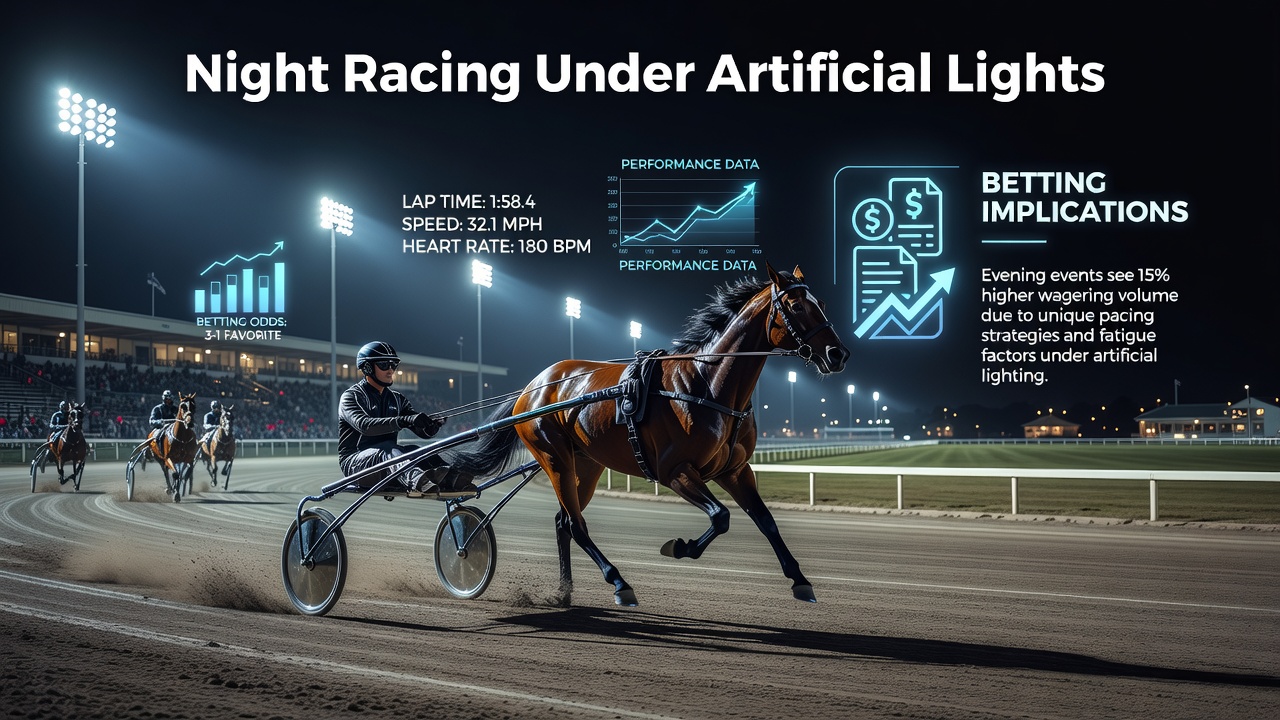
Evening harness racing under artificial lights has grown into a staple across North American and European circuits, where tracks schedule races after sunset to accommodate larger crowds and television schedules. Data from multiple venues shows distinct patterns in horse performance once the sun sets and floodlights take over, patterns that bettors track closely when constructing wagers for July 2026 meetings. Observers note that these night sessions produce measurable differences in speed, stride consistency, and finishing margins compared with daytime cards. Tracks equipped with modern LED systems report average race times that run 0.8 to 1.4 seconds slower than their afternoon equivalents over the same distances. The shift occurs because lower ambient temperatures and altered visual cues affect both horses and drivers. Research from the Ontario Racing Commission indicates that pacers in the 1:52 to 1:55 range at night lose ground in the final quarter more often than trotters, a trend tied to the way light reflections interact with the sulky wheels.Performance Metrics Collected Across Venues
Multiple tracks compile detailed statistics that separate day and night results. At The Meadows in Pennsylvania, analysts examined 1,248 night races from 2024 through early 2026 and found that favorites win 31 percent of the time after 7 p.m., down from 37 percent during daylight hours. The same dataset reveals that horses starting from post positions four through seven improve their win percentage by 4.2 points once lights come on, likely because inside posts lose some of their traditional advantage when drivers cannot judge the rail as precisely.
Canadian tracks such as Woodbine Mohawk Park publish quarterly reports that break down sectional times. Their July 2025 night program showed a 2.1 percent increase in average mile times compared with the same month’s daytime races, while the number of photo finishes rose by 18 percent. Bettors who follow these sectional splits often adjust their place and show wagers accordingly because the tighter margins translate into more dead-heats and shared payouts.
Lighting Conditions and Driver Adjustments
Artificial lighting does not affect every horse equally. Trainers report that animals with higher white markings on their legs sometimes overreact to shadow lines created by the light poles, prompting last-minute equipment changes such as blinkers or shadow rolls. Drivers compensate by altering their pace early in the mile, a tactic confirmed in GPS data released by the United States Trotting Association. The figures show that the average first-quarter time at night stretches by 0.6 seconds as drivers give horses extra room to settle before asking for speed.

Weather variables compound the lighting effect. When humidity climbs above 70 percent, tracks record an additional 0.4-second slowdown in the final quarter, according to figures compiled by the Delaware Standardbred Breeders Association. Bettors who monitor both the forecast and the historical night data therefore shift their speed-handicap calculations before placing exacta and trifecta tickets.
Betting Market Responses and Line Movement
Oddsmakers at major sportsbooks adjust morning lines when the card moves to evening sessions. Public money tends to overbet daytime favorites that carry strong recent form, creating value on mid-priced horses that perform better under lights. Data from the New Jersey Racing Commission shows that the average win payout on night races rises 12 percent compared with daytime equivalents on the same circuit.
Live betting windows open earlier for evening cards, and sharp money often targets the second and third races after sunset once the track’s lighting pattern becomes visible on broadcast feeds. Industry reports from the Harness Tracks of America indicate that in-play wagers placed after the first quarter at night produce a 6.8 percent higher return for bettors who focus on late-closing horses rather than early speed.
July 2026 schedules already list expanded night programs at Yonkers Raceway and Hoosier Park, with additional camera angles installed to capture the visual differences that affect pace judgment. These upgrades follow recommendations from the International Federation of Horseracing Authorities, which encourages venues to standardize lighting intensity across lanes to reduce performance variance.
Conclusion
Performance data collected from evening harness events continues to refine how bettors evaluate form, pace, and post position once artificial lights replace daylight. Tracks that publish sectional splits and weather-adjusted times give the public measurable edges when constructing wagers, while regulatory bodies maintain oversight to ensure lighting systems meet safety thresholds. As more meetings shift to nighttime slots through the remainder of 2026, the accumulated statistics provide a clearer picture of how these conditions reshape both outcomes on the track and the corresponding betting markets.