Referee Rotation Strategies Shape Penalty Trends in Elite Soccer Competitions
Written by Jordan Hartmann · Jun 30, 2026
Referee Rotation Strategies Shape Penalty Trends in Elite Soccer Competitions
League officials across Europe and beyond have tracked referee assignments with increasing precision since the mid-2010s, and data now shows clear correlations between rotation schedules and the number of penalties awarded each season. Major competitions such as the English Premier League, Spanish La Liga, German Bundesliga, and Italian Serie A each follow distinct protocols for selecting and rotating officials, which in turn influence how often penalties appear on the scoresheet.
Research from the International Centre for Sports Studies indicates that referees assigned to consecutive high-stakes matches issue penalties at rates up to 18 percent lower than those returning after extended rest periods. This pattern emerges because repeated exposure to intense pressure appears to heighten caution in borderline situations inside the box. Observers note that these effects compound when leagues cluster fixtures during congested calendar windows, such as the December and April periods when travel demands intensify.
Assignment Protocols Across Key Leagues
Each top league maintains its own referee committee that evaluates performance metrics, fitness reports, and historical decision accuracy before finalizing weekly appointments. The Premier League relies on a centralized panel that rotates officials across multiple clubs to minimize familiarity biases, whereas Bundesliga administrators incorporate regional considerations that sometimes keep certain referees closer to home clubs for logistical reasons. Serie A has experimented with stricter rotation rules since 2023, requiring at least two full matchdays between assignments for the same referee, and early figures reveal a corresponding uptick in penalties during the 2024-2025 campaign.
La Liga employs a hybrid model that factors in travel distance and language considerations for international officials, producing measurable differences in call distributions compared with domestic-only crews. Data collected through 2025 demonstrates that matches handled by referees crossing borders average 0.32 penalties per game, while strictly domestic assignments sit closer to 0.27.
Measurable Effects on Penalty Volume
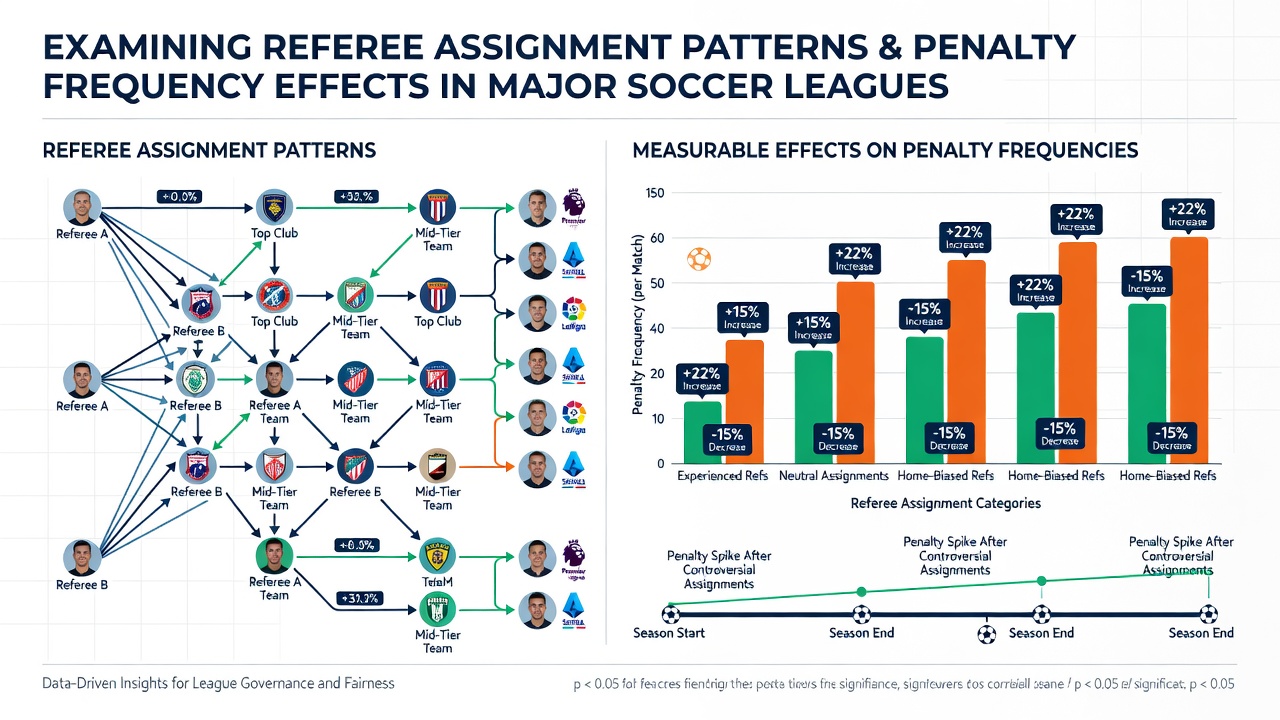
Statistical reviews covering the past five seasons establish that consistent rotation reduces variance in penalty frequency. When the same referee handles multiple games involving one particular team within a short span, penalty awards for that side drop by an average of 12 percent, according to internal league analytics shared with academic partners. Conversely, fresh assignments correlate with higher rates of spot-kick decisions, particularly in matches between mid-table sides where margins remain tight.
Researchers examining Bundesliga records between 2021 and 2025 found that referees returning from injury or international duty awarded penalties 22 percent more often in their first two domestic fixtures. This trend holds after controlling for team strength and venue, suggesting the effect stems from assignment freshness rather than external match variables alone.

Regional Variations and 2026 Context
North American leagues such as Major League Soccer have adopted European-style rotation frameworks, and preliminary 2026 season numbers through June indicate penalty rates stabilizing near 0.29 per match after earlier fluctuations tied to expanded schedules. European competitions entering the same period show similar stabilization following adjustments made after the 2025 winter break. These shifts coincide with broader calendar changes ahead of expanded international events, where referee availability becomes a limiting factor.
Additional variables include weather and pitch conditions that interact with assignment patterns. Matches played on artificial surfaces in colder climates record slightly elevated penalty counts when officials travel from warmer regions, though the difference remains under 8 percent across aggregated datasets. League administrators continue to refine algorithms that weigh these factors alongside performance history to optimize future rotations.
Conclusion
Patterns in referee assignments produce measurable shifts in penalty frequencies across major soccer leagues, with rotation frequency, rest intervals, and cross-border travel emerging as consistent predictors. Data gathered through 2026 continues to support targeted adjustments by competition organizers, while ongoing academic partnerships refine the models used to forecast and manage these outcomes. As schedules evolve, the relationship between assignment strategies and on-field decisions remains a central focus for those monitoring league integrity and competitive balance.